

AI Tools Blog
ElevenLabs Realtime API: Mini vs Max for Voice Agents

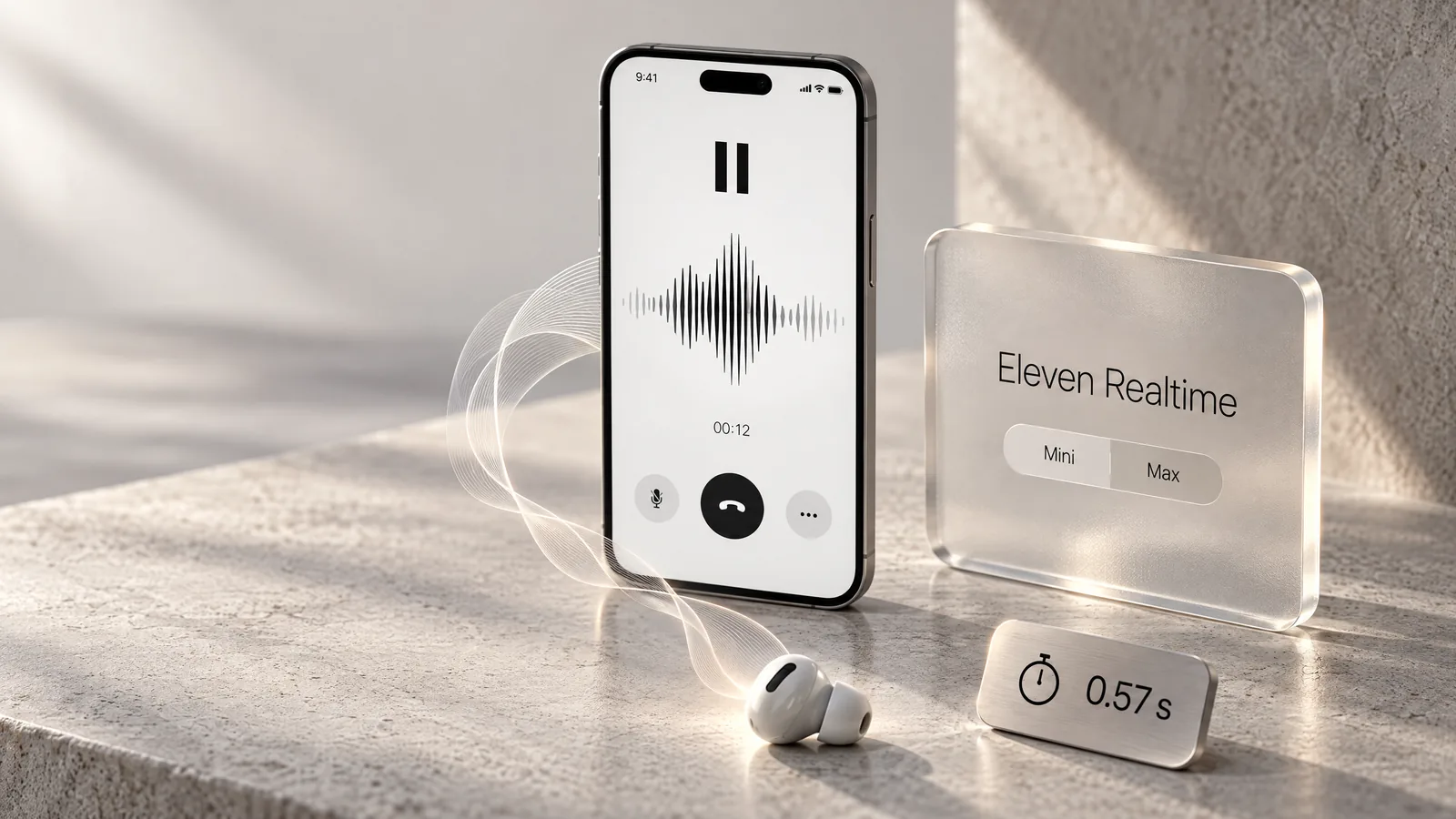
The ElevenLabs Realtime API, launched on October 20, 2026, gives you a complete voice agent behind one model ID, in two sizes: the cheaper, conversational v1 Mini and the reasoning v1 Max. Both bill the same $0.08 per connected minute, speak OpenAI's Realtime protocol and support more than 90 languages; the gap is in token prices, task accuracy and enterprise options. Instead of restating the launch post, this piece puts the two models side by side, works out what a minute really costs, and lists the catches you hit when migrating an existing OpenAI Realtime app.
- Eleven Realtime shipped on October 20, 2026 as two models: v1 Mini (the default) and v1 Max, which reasons before it speaks.
- In Artificial Analysis testing, Max scored 98.8% on spoken reasoning and 87.1% on tool-use tasks versus 75.9% and 60.3% for Mini; time to first audio is 0.57 s and 0.62 s.
- Both cost $0.08 per connected minute plus LLM tokens; Max tokens cost more, landing at roughly 8 to 10 cents a minute in total.
- The Realtime API follows OpenAI's Realtime spec, so migration is often an endpoint and model-name change, but it is WebSocket only.
- Access is rolling out gradually, and Max is limited to US and EU data residency.
What Eleven Realtime actually is
Most production voice agents are a chain: a speech recognizer, voice activity detection to decide when the caller has finished, an LLM to write the reply, and a text-to-speech model to say it. Each hop adds latency, and tuning which LLM pairs well with which voice is left to you. Eleven Realtime, announced by ElevenLabs on October 20, 2026, collapses that chain into a single model ID: audio in, audio out.
It is not a single end-to-end network. ElevenLabs’ docs describe a cascaded system (speech recognition, voice activity detection, turn-taking, LLM and TTS) where the company picks the components and tunes them as one. That design has a practical upside: because each stage produces text, you can see what the agent heard and what it decided to say, which is what lets guardrails and PII redaction work inside ElevenAgents.
There are two models. Eleven Realtime v1 Mini is the default, aimed at assistants, tutors and interactive characters, and ElevenLabs says it should cover most use cases. Eleven Realtime v1 Max reasons before it responds and targets customer support, lead qualification and workflows that call several tools in sequence.
Mini vs Max: the numbers
The table combines the Artificial Analysis results published in ElevenLabs’ launch post with details from its docs and API pricing page (checked October 31, 2026):
| Metric | v1 Mini | v1 Max |
|---|---|---|
| Average time to first audio | 0.62 s | 0.57 s |
| Big Bench Audio (1,000 spoken reasoning questions) | 75.9% | 98.8% |
| Tool-use tasks | 60.3% | 87.1% |
| Full-Duplex-Bench (conversational dynamics) | 95.8% | 94.1% |
| Speech Agent Arena (human preference) | 988 | 998 |
| Connected audio | $0.08/min | $0.08/min |
| Input / output tokens (per 1M) | $0.20 / $6.00 | $1.80 / $9.00 |
| Data residency | US, EU, India, Singapore | US, EU |
| Zero Retention Mode and HIPAA | No | Yes, in US and EU |
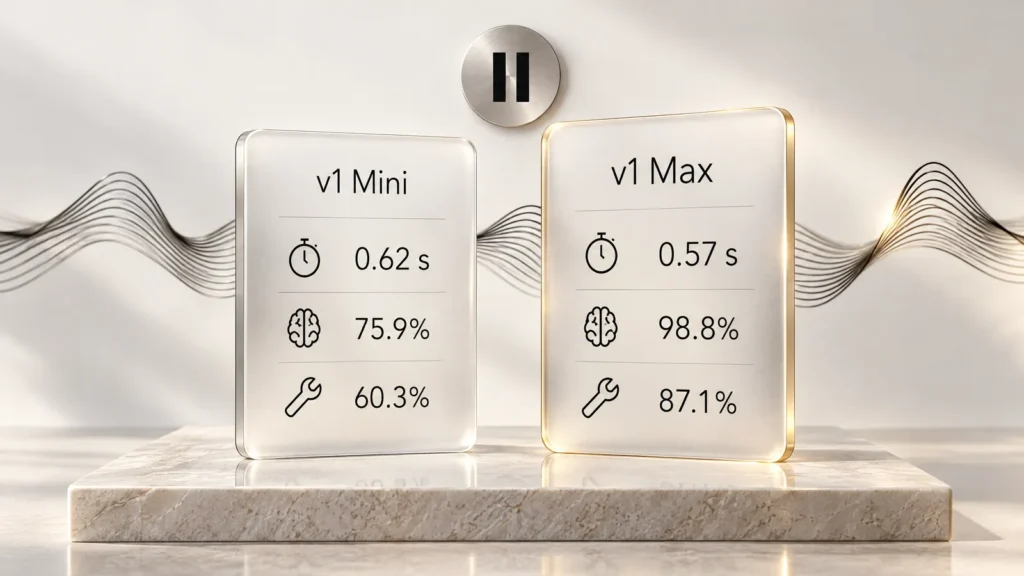
The pattern is clear. Max starts speaking slightly sooner and is far more reliable when it has to reason or call tools. Mini scores a little higher on conversational flow, meaning interruptions and turn-taking. For a chatty assistant that answers and keeps the conversation going, Mini is enough; for an agent that books appointments, looks up orders or opens returns, Max is where the accuracy gap should pay off.
How it stacks up against other speech-to-speech models
i-SCOOP reproduced the Artificial Analysis comparison on October 21 alongside other vendors. On those figures Max had the fastest time to first audio, but Grok Voice 3.0 (94.8%) and Gemini 3.8 Live (93.2%) completed more tasks, and both scored higher on blind human preference. Neither Eleven model had an overall Speech-to-Speech Index score yet. In short, Max wins on speed and reasoning; whether it finishes long, multi-step calls as often as rivals is something to measure on your own traffic.
Eleven Realtime pricing: what a minute really costs
Billing has two parts. Connected audio is $0.08 per minute on both models. On top of that you pay for the tokens the underlying LLM consumes: $0.20 per million input and $6.00 per million output on Mini, $1.80 and $9.00 on Max. Traffic above your concurrency limit is billed as burst at $0.16 per minute. Inside ElevenAgents, Realtime agents pay the standard agent per-minute rate plus input, cached input and output tokens at the model’s rates.
ElevenLabs does not publish how many tokens a typical minute uses. Working backwards from the included-minute estimates on the pricing page, i-SCOOP put the all-in cost at about $0.084 per minute for Mini and about $0.102 for Max, so Max runs roughly a fifth more. The same page lists estimated Realtime minutes included with each plan (checked October 31, 2026):
| Plan (monthly) | Mini (est. minutes) | Max (est. minutes) | Concurrent calls |
|---|---|---|---|
| Free | ~14 | ~12 | 4 |
| Starter ($6) | ~71 | ~59 | 6 |
| Creator ($22) | ~262 | ~216 | 10 |
| Pro ($99) | ~1,179 | ~971 | 20 |
| Scale ($299) | ~3,562 | ~2,934 | 30 |
| Business ($990) | ~11,794 | ~9,714 | 40 |
ElevenLabs notes these are estimates based on typical token usage and that real minutes vary with conversation length and tool use. A rough planning example: an hour of connected audio is $4.80 before tokens on either model. If your agent carries a long system prompt or a large knowledge base, Max’s higher input price grows that bill faster than Mini’s.
Migrating from OpenAI’s Realtime API
The headline for developers is compatibility. ElevenLabs says its Realtime API speaks the same wire protocol as OpenAI’s, with the same client and server events over WebSocket. If you built on OpenAI’s Agents SDK, the migration guide has you keep the SDK, point it at wss://api.elevenlabs.io/v1/convai/realtime and set the model to eleven_realtime_v1_mini or eleven_realtime_v1_max.
It is not a perfect drop-in, though:
- WebSocket only. WebRTC integrations need to move to WebSocket first, and over WebSocket you handle 24 kHz PCM16 audio yourself rather than letting the SDK wire it up.
- Short-lived credentials. Your backend mints a client secret so the ElevenLabs API key never reaches the browser; the session config sent at that point is the authoritative starting session.
- Browser-first docs. The guide covers browser connections; documentation for server-side OpenAI Realtime SDKs had not been published when we checked.
- No platform extras. The bare API runs separately from ElevenAgents, so phone lines, messaging channels, the knowledge base and monitoring are not available there. ElevenLabs recommends building on ElevenAgents if you need them.
Turning on Realtime in ElevenAgents
- Open your agent and go to the Agent tab.
- Set Voice mode to Realtime. This selects Mini.
- Optionally pick Max from the Model list. Max needs a token limit of at least 1,024, or no limit.
- Configure the system prompt, first message, voice, languages, tools and knowledge base as usual; these still apply.
- Publish. Constraints are validated at publish time.
You can do the same from the CLI by setting conversation_config.realtime_model, or through agents.update in the API. In Realtime mode ElevenLabs manages the LLM, reasoning effort, thinking budget, parallel tool calls, TTS model and ASR provider, so those settings are ignored. Custom LLMs and Amazon Bedrock are not supported, transfers only work between Realtime agents (Mini to Max is fine), and the mode is not meant for text-only agents. If the Voice mode setting is missing, Realtime has not reached your workspace yet; the API returns an error in that case too.
Which one should you pick?
- Choose Mini for language tutors, in-app or game characters and FAQ-style assistants, where low token cost and natural turn-taking matter most.
- Choose Max for support and sales agents that call tools, query records and run multi-step flows, and for deployments that need Zero Retention Mode or HIPAA in the US or EU.
- Use both by greeting callers with Mini and handing complex requests to Max, since Realtime agents can transfer to each other.
One compliance note for teams serving European users: i-SCOOP points out that Article 50(1) of the EU AI Act has applied since August 2, 2026, so callers must be told they are speaking with an AI system. Before you commit, measure cost per completed call, transfer rates, your own languages and accents, and real phone-line conditions rather than relying on benchmark tables alone.
If you want to try Realtime on a paid ElevenLabs plan, the Creator tier is estimated at about 262 Mini minutes a month. The related option in our store is below; its scope is exactly as described on the product page, and whether Realtime appears in your workspace depends on ElevenLabs’ gradual rollout.
 ElevenLabs Creator – 131,000 Credits, 1 MonthIn stock Price range: $6.00 through $10.00
Frequently asked questions
What is the ElevenLabs Realtime API?
It is ElevenLabs' speech-to-speech API, launched on October 20, 2026, that exposes a complete voice agent (speech recognition, turn-taking, LLM and TTS tuned as one system) behind a single model ID. It comes in two models, v1 Mini and v1 Max, and follows OpenAI's Realtime API specification over WebSocket.
How much does Eleven Realtime cost?
Connected audio is $0.08 per minute on both models, plus LLM tokens: $0.20 input and $6.00 output per million on Mini, $1.80 and $9.00 on Max. Burst traffic above your concurrency limit is $0.16 per minute. i-SCOOP estimates the all-in cost at about 8.4 cents a minute for Mini and 10.2 cents for Max.
Is Eleven Realtime v1 Max better than Mini?
For reasoning and tool use, yes: Max scored 98.8% on Big Bench Audio and 87.1% on tool-use tasks versus 75.9% and 60.3% for Mini. Mini is slightly better on conversational flow and is cheaper per token, so it remains the default for simpler assistants.
Can I switch from OpenAI's Realtime API without rewriting my app?
Usually most of it stays. You keep the OpenAI Agents SDK, change the endpoint to ElevenLabs' WebSocket URL and set the Eleven Realtime model name. You will need to move off WebRTC if you use it, handle 24 kHz PCM16 audio yourself, and mint short-lived credentials on your backend.
Which languages does Eleven Realtime support?
More than 90. ElevenLabs points to the Eleven v4 language list, and any of the 17,000+ voices in its library can be used.
Why don't I see Realtime in my ElevenAgents dashboard?
ElevenLabs is rolling the models out gradually. If the Voice mode setting does not appear on the Agent tab, Realtime is not yet available for your workspace, and the API will reject Realtime requests until it is.
Sources
- Introducing Eleven Realtime: a simpler way to build natural voice agents — ElevenLabs, 31 October 2026
- Realtime models — ElevenLabs Docs, 31 October 2026
- Models overview — ElevenLabs Docs, 31 October 2026
- ElevenLabs API Pricing — ElevenLabs, 31 October 2026
- OpenAI Realtime compatibility — ElevenLabs Docs, 31 October 2026
- Eleven Realtime speaks OpenAI's protocol, and that makes voice agents easier to switch — i-SCOOP, 31 October 2026