AI Tools Blog
Gemini 4 Hydrogen vs Argon: Speed, Price and Plans

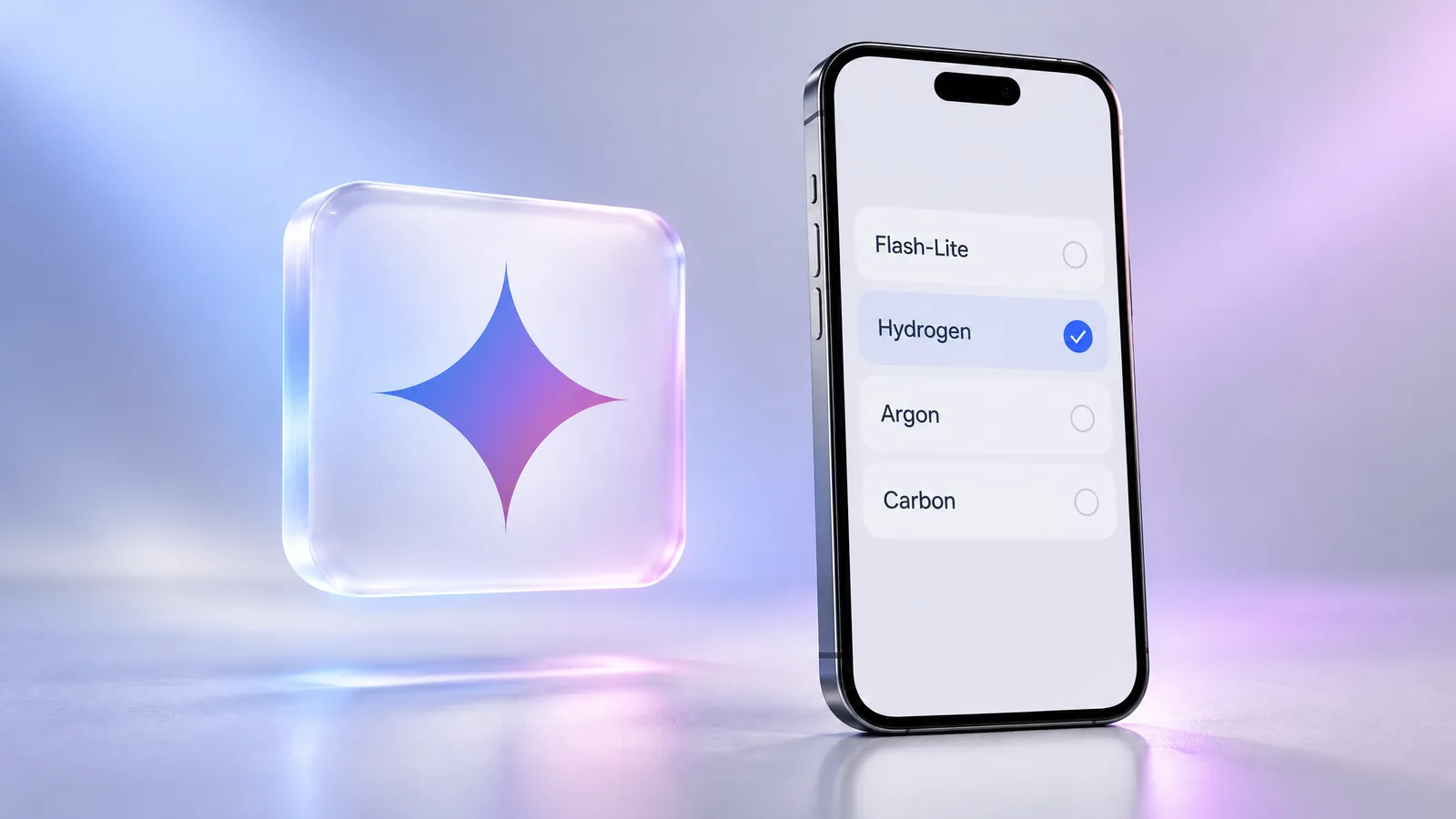
Gemini 4 Hydrogen vs Argon comes down to this: Hydrogen is Google's fast, low-cost Gemini 4 model released on November 12, 2026, and Google's own numbers put it level with Argon on general intelligence at less than half the API price. Argon is still the model Google recommends for long coding and analysis work, and it needs a pricier plan. Below we compare the two (plus Carbon and the outgoing 3.8 Flash) with the figures that matter when you pick a plan or budget an API project: what a typical job costs before and after the December 1 price change, which benchmarks each model wins, and where Hydrogen falls short.
- Hydrogen replaces Gemini 3.8 Flash; Google calls it the daily driver for agentic work, while Argon and Carbon handle long, deep reasoning.
- On the Artificial Analysis Intelligence Index, Google reports Hydrogen at 51 (default) and 54 (highest setting) versus 50 for Argon.
- API pricing: Hydrogen is $1.50 input / $7.50 output per million tokens; Argon is $2 / $10 until November 30, then $4 / $20.
- In the Gemini app, Hydrogen is selectable from AI Plus ($4.99/month); Argon needs AI Pro ($19.99) and Carbon needs AI Ultra ($99.99+).
- Hydrogen is on the free API tier; Argon and Carbon are not.
What is Gemini 4 Hydrogen?
Google announced Gemini 4 Hydrogen on November 12, 2026, in a post by Koray Kavukcuoglu of Google DeepMind. Google positions it as the daily driver for agentic workflows: the larger Gemini 4 Carbon and Gemini 4 Argon are built for deep, long-horizon reasoning, while Hydrogen focuses on rapid execution. 9to5Google notes that it effectively succeeds Gemini 3.8 Flash and that Google dropped the Flash name with this generation.
Per the DeepMind model card, Hydrogen takes text, images, audio and video as input, supports up to 1 million tokens of combined input and output, returns up to 64K tokens synchronously by default, and has a March 2026 knowledge cutoff. It has four thinking levels: low, medium, high (the API default) and a new extra-high tier, labeled xhigh in the announcement and Extra in Antigravity.
It ships everywhere at once: the Gemini app, Google Search, Google Sheets, the Gemini API and AI Studio, Gemini for business, and Google Antigravity. That completes Google’s Gemini 4 lineup within a month: Argon went generally available on October 13, Carbon on November 10, Hydrogen on November 12.
Gemini 4 Hydrogen vs Argon vs Carbon at a glance
Prices below are Google’s standard API tier per 1 million tokens, from the Gemini API pricing page; plan details come from the Gemini Help Center and Google’s subscription page (all checked November 14, 2026).
| Gemini 4 Hydrogen | Gemini 4 Argon | Gemini 4 Carbon | Gemini 3.8 Flash | |
|---|---|---|---|---|
| Google’s positioning | Everyday help, fast agentic work | Code and analysis | Most complex work | Previous fast model |
| Cheapest app plan to select it | AI Plus, $4.99/mo (free users via Auto) | AI Pro, $19.99/mo | AI Ultra, from $99.99/mo | No longer in the app menu |
| API input | $1.50 | $2.00, then $4.00 from Dec 1 | $2.00, then $4.00 from Dec 1 | $0.75, then $1.50 from Jan 1, 2027 |
| API output (incl. thinking) | $7.50 | $10.00, then $20.00 from Dec 1 | $10.00, then $20.00 from Dec 1 | $3.75, then $7.50 from Jan 1, 2027 |
| Free API tier | Yes | No | No | Yes |

Two pricing details are easy to miss. First, 3.8 Flash looks cheaper today, but its price doubles on January 1, 2027 to exactly Hydrogen’s rate, so there is little reason to build anything new on it. Second, Argon and Carbon share one price list, and after December 1 both cost about 2.7 times as much as Hydrogen per token.
Benchmarks: where Hydrogen beats Argon, and where it doesn’t
Google’s headline claim is that Hydrogen scores 51 on the Artificial Analysis Intelligence Index at its default setting, one point above Argon’s 50, and 54 at the highest setting. Against its predecessor, Google reports roughly 2.5x the speed of 3.8 Flash at the high thinking level, 57% versus 18.2% on Terminal-Bench 4.1, and more than five times fewer fabricated claims.
The model card compares Hydrogen with two models in its class. These are Google’s own results:
| Benchmark | Gemini 4 Hydrogen | Claude Sonnet 5.5 | GPT-6.1 Terra |
|---|---|---|---|
| Agents’ Last Exam v1.1 | 71.6% | 60.4% | 69.8% |
| AutomationBench-AA | 76.1% | 71.8% | 60.2% |
| HLE-Diamond | 58.8% | 53.3% | 47.3% |
| Vending-Bench 2 (final balance) | $14,549 | $11,165 | $9,107 |
| Terminal-Bench 4.1 | 57.0% | 63.9% | n/a |
| OSWorld-2.1 (offline subset) | 77.6% | 83.9% | 74.2% |
The pattern is consistent: Hydrogen leads on knowledge work and reasoning, and trails Sonnet 5.5 on terminal coding and computer use. A single index point over Argon does not make Argon redundant either. In the Carbon announcement two days earlier, Google still described Argon as the ideal choice for the majority of software engineering and knowledge work. Treat Hydrogen as the fast default and Argon as the step up when a task is long, multi-file or multi-step.
What a typical job costs
To make the price gap concrete, take one job that reads 1 million input tokens and produces 200,000 output tokens (thinking tokens are billed as output):
- Hydrogen: $1.50 + $1.50 = $3.00
- Argon or Carbon until November 30: $2.00 + $2.00 = $4.00
- Argon or Carbon from December 1: $4.00 + $4.00 = $8.00
- 3.8 Flash until December 31: $0.75 + $0.75 = $1.50, rising to $3.00 in January
Batch and Flex processing halve Hydrogen’s rates to $0.75 and $3.75, and cached input costs $0.075 per million tokens. Google says Hydrogen’s price stays flat across the full 1 million-token window. One caveat from the model card: Hydrogen may spend more tokens at higher thinking levels to maximize performance, so a job run at xhigh will not cost the same as one at low. Budget with the thinking level you actually plan to use.
Which plan gets you Hydrogen in the Gemini app
The Gemini Help Center’s model table no longer lists a separate Flash option; Hydrogen took its place. Here is who can pick what (US prices, checked November 14, 2026):
| Plan | Price | Chat models | Task mode models |
|---|---|---|---|
| Free | $0 | Auto or Flash-Lite | None |
| AI Plus | $4.99/mo | Flash-Lite, Hydrogen | None |
| AI Pro | $19.99/mo | Flash-Lite, Hydrogen, Pro, Argon | Hydrogen, Argon |
| AI Ultra | $99.99 or $199.99/mo | Flash-Lite, Hydrogen, Argon, Carbon | Hydrogen, Argon, Carbon |
Free users cannot pick Hydrogen. With auto model selection on, Gemini routes each prompt itself, usually to Flash-Lite and sometimes to Hydrogen; with it off, every reply comes from Flash-Lite. If you are on the free plan, leave the toggle on under Settings then Usage limits. On paid plans, tap the model name under the chat box and choose Hydrogen; the app defaults to the Low thinking level unless you change it. When you hit a usage limit, Gemini continues in Flash-Lite.
Outside the app, Hydrogen is now the default model in Search’s AI Mode for everyone, according to 9to5Google, and handles the hardest questions in AI Overviews. In Antigravity it is limited to paid AI Pro and Ultra subscribers, where a new Orchestrator mode lets Carbon hand routine steps to Hydrogen; Google reports near-Carbon results on Terminal-Bench 4.0 with 24% less quota used.
Which one should you use?
- Pick Hydrogen for drafting, summaries, spreadsheet work, short code tasks and anything where speed matters. It is also the only Gemini 4 model you can test on the free API tier, under the model ID gemini-4-hydrogen.
- Pick Argon for long documents, multi-file comparisons and multi-step coding where Google still recommends it, and only if the task justifies a price that doubles on December 1.
- Pick Carbon only on AI Ultra or a paid API project, for the hardest problems.
- Stop planning around 3.8 Flash. It is gone from the app menu and reaches Hydrogen’s price in January.
If you want Hydrogen in every chat without thinking about routing, AI Plus is the cheapest way in. If you also need Argon, task mode or Gemini in Sheets, AI Pro is the step up.

Frequently asked questions
Is Gemini 4 Hydrogen free?
Partly. Free Gemini app users can't select it, but auto model selection sends some prompts to it. It is the default model in Search's AI Mode, and it is available on the free tier of the Gemini API and in Google AI Studio.
Is Gemini 4 Hydrogen better than Argon?
On Google's reported Artificial Analysis Intelligence Index, Hydrogen scores 51 at its default setting versus 50 for Argon, and it is much faster and cheaper. Google still recommends Argon for most long software engineering and knowledge work, so for multi-step, multi-file jobs Argon remains the safer pick.
How much does Gemini 4 Hydrogen cost on the API?
$1.50 per million input tokens and $7.50 per million output tokens on the standard tier, with batch and Flex at half that. Google says the price is flat across the full 1 million-token context window.
Does Hydrogen replace Gemini 3.8 Flash?
In practice, yes. Google pitches it as an upgrade for teams migrating from 3.8 Flash, and the Gemini app menu no longer shows a Flash option. 3.8 Flash is still on the API, but its price doubles on January 1, 2027 to match Hydrogen's.
Which Google AI plan do I need for Argon and Carbon?
Argon needs AI Pro ($19.99 per month). Carbon needs AI Ultra, which starts at $99.99 per month. Neither model is on the free API tier.
Sources
- Introducing Gemini 4 Hydrogen for Agentic Workflows — Google, 14 November 2026
- Gemini 4 Hydrogen Model Card — Google DeepMind, 14 November 2026
- Gemini Developer API pricing — Google AI Studio, 14 November 2026
- Choose a model and thinking level — Google Help Center, 14 November 2026
- Google AI plans — Google, 14 November 2026
- Gemini 4 Carbon is now available — Google, 14 November 2026
- Google announces Gemini 4 Hydrogen with 'significant leaps' in speed, intelligence — 9to5Google, 14 November 2026