

AI Tools Blog
ChatGPT Advanced Voice Mode Is Retiring: What to Know

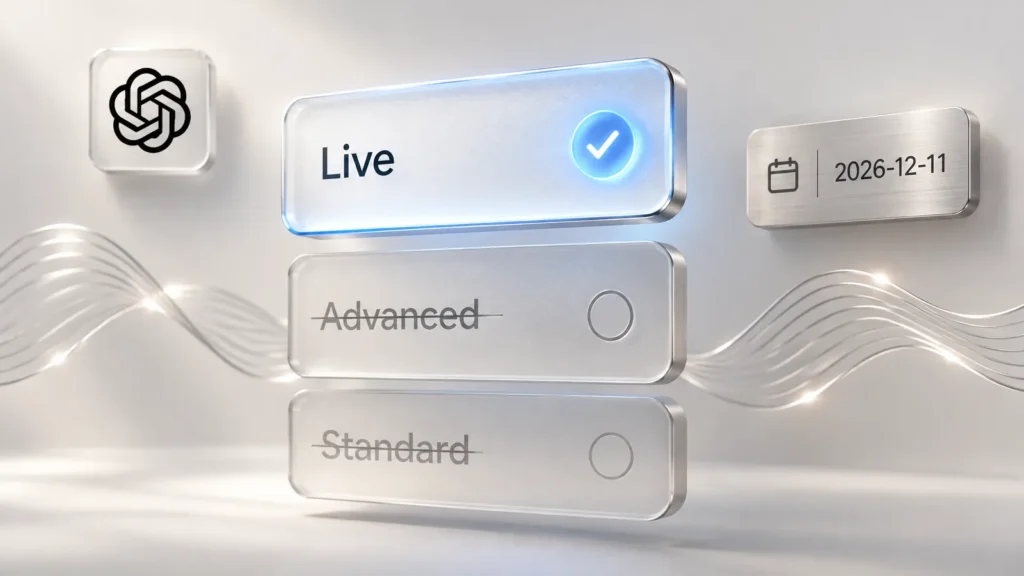
ChatGPT Advanced Voice Mode and the older Standard Voice disappear from the voice picker on December 11, 2026, and anyone still using them will be moved to GPT-Live, the full-duplex voice model OpenAI launched in July. The announcement itself is short, but the details matter: video and screen sharing are not affected yet, custom GPTs are, and the daily limits depend on which GPT-Live model your plan gets. This guide covers what changes, what stays, and what to check before the switch.
- On December 11, 2026, Advanced and Standard Voice are removed from Settings > Voice; users who had either selected are switched to Live automatically.
- Live video and screen sharing keep running on Advanced Voice until GPT-Live supports them; OpenAI has given no date.
- Voice with custom GPTs uses Advanced Voice only until December 11; past voice conversations stay in your history.
- Voice is metered over a rolling 24 hours: Go and Plus get 3 hours, Pro at $100 gets 15 hours, and Free gets a limited, unpublished amount.
- Free and Go run the smaller GPT-Live-1.1 Quip model; Plus and above get the full GPT-Live-1.1.
The timeline
OpenAI began notifying users on November 10, 2026, through the ChatGPT release notes and a dedicated help article. The schedule has two parts:
- Now until December 10: a transition period. If you prefer Advanced or Standard Voice, you can keep using it.
- December 11, 2026: both options are removed from the model picker under Settings > Voice. Anyone who had one of them selected is defaulted to Live, which is GPT-Live.
There is nothing to migrate by hand. Conversations held with the outgoing models remain in your history, and OpenAI says you can continue them in text or with the new voice experience.
The stated reason is adoption. According to OpenAI, voice usage in ChatGPT has nearly doubled since GPT-Live arrived, and virtually everyone who uses voice is already on it. In other words, December 11 mainly affects the minority who deliberately switched back to an older mode.
How the three voice modes differ
The retiring modes and GPT-Live are built in fundamentally different ways. Based on OpenAI’s descriptions as reported by Interesting Engineering and Dataconomy:
| Mode | How it works | Main weakness | After December 11 |
|---|---|---|---|
| Standard Voice | Chains three models: speech-to-text, a text model, then text-to-speech | Slow, and tone and other cues get lost in transcription | Removed |
| Advanced Voice | One model that processes audio natively, but strictly turn by turn | Waits for you to stop talking; interruptions feel rigid | Removed from the picker; still powers video and screen sharing for now |
| GPT-Live | Full-duplex model that listens and speaks at the same time | No video or screen sharing yet | The only selectable option |
In practice, GPT-Live feels less like a walkie-talkie. It can give short acknowledgments while you are still speaking, stop when you cut in, and stay quiet when you need a moment to think. When a question needs web search, deeper reasoning or several steps, it hands the work to one of OpenAI’s text models in the background and folds the answer back into the conversation without hanging up. When OpenAI introduced GPT-Live on July 8, 2026, that background model was GPT-5.5, and the company said it would swap in newer models as they ship.
OpenAI also says it will carry lessons from the older modes into GPT-Live, focusing on response depth and detail, continuity across conversations, and personalization. That is a useful hint at what long-time Advanced Voice users have found missing.
Daily voice limits by plan
OpenAI’s ChatGPT Voice help article measures usage over a rolling 24-hour window, so minutes come back 24 hours after you use them rather than at midnight. Since October 15, 2026, there are two models: the smaller GPT-Live-1.1 Quip and the full GPT-Live-1.1. Checked on November 15, 2026:
| Plan | Voice model | Voice time per 24 hours |
|---|---|---|
| Free | GPT-Live-1.1 Quip | Limited; no figure published |
| Go | GPT-Live-1.1 Quip | 3 hours |
| Plus | GPT-Live-1.1 | 3 hours |
| Pro ($100/month) | GPT-Live-1.1 | 15 hours |
| Pro ($200/month) | GPT-Live-1.1 | No hourly cap listed; abuse guardrails apply |
Two details are easy to miss. Since September 9, 2026, Plus and Pro subscribers are no longer dropped to a smaller model when they hit the cap: the voice session simply ends, and you continue in text or wait for time to free up. Business plans work differently: once the included hours are used, voice keeps going and draws 1.25 workspace credits per minute.
Go and Plus get the same three hours, but not the same model. If you use voice for long, detailed conversations, such as interview practice or talking through a document, the full model on Plus is the more consistent choice.
What keeps working, and what does not
December 11 removes two selectable modes. It does not remove every feature that runs on Advanced Voice.
- Live video and screen sharing: these continue on Advanced Voice until GPT-Live gains the capability. OpenAI has not given a timeframe. Pointing your camera at something and asking about it will keep working after December 11.
- Custom GPTs: voice conversations with custom GPTs run on Advanced Voice until December 11, when that ends. OpenAI has not detailed how voice with custom GPTs will behave afterwards, so if a workflow depends on one, test it again in December.
- Your history: nothing is deleted. Old voice chats stay put and can be resumed.
Languages and voices
OpenAI does not publish an official language list for GPT-Live. Its guidance is that the model is optimized for the languages most used in ChatGPT and that others may show accent or fluency gaps. The GPT-Live-1.1 update on October 15 added native voices for French, German, Hindi, Japanese, Korean and Mexican Spanish, plus a new English voice called Bubbie. If you mainly speak one of those languages, it is worth revisiting the voice list. You can change voices under Settings > Voice.
A checklist before December 11
- Open Settings > Voice and see which model is selected. If it already says Live, nothing changes for you.
- If Advanced or Standard is selected, switch to Live now and use it for a few days instead of being moved on the deadline.
- Pick a voice you like from the same menu; the new model sounds different from what you are used to.
- Start a voice chat with the Voice button next to the message box on iOS, Android or ChatGPT.com.
- If you regularly talk for more than three hours a day, compare your usage with the table above and expect sessions to end at the cap.
- If you rely on a custom GPT in voice, plan to retest it after December 11 and keep its instructions handy in case you need to move them into a regular chat.
For developers
GPT-Live is also in the API. According to OpenAI’s developer docs, gpt-live-1 takes audio and text and returns audio and text; it does not accept images or video. Voice sessions cost $0.05 per minute, billed per second, and the background model and tool calls are billed separately at their normal rates. The model runs only on the new Live sessions endpoint, not on Realtime or Responses.
If you want the full GPT-Live-1.1 model and three hours of daily voice, the Plus plan is available in our store:
 ChatGPT Plus – 30 Days Ready AccountIn stock Price range: $5.50 through $11.00
Bottom line
After December 11, 2026, ChatGPT Advanced Voice Mode and Standard Voice are gone from the picker and GPT-Live is the only voice model. Most people will not notice, because they are already on it. Video and screen sharing keep working for now, custom GPT voice needs a retest, and your daily allowance depends on which GPT-Live model your plan includes. Switching a few weeks early is the easiest way to find out whether the new model suits the way you talk.
Frequently asked questions
Is ChatGPT Advanced Voice Mode going away?
Yes. OpenAI says Advanced and Standard Voice will be removed from the voice picker on December 11, 2026, and users who had them selected will be moved to GPT-Live. Live video and screen sharing continue on Advanced Voice until GPT-Live supports them.
What is GPT-Live?
GPT-Live is OpenAI's full-duplex voice model, launched in ChatGPT on July 8, 2026. It listens and speaks at the same time and hands search, reasoning and multi-step tasks to a text model in the background without ending the conversation.
How long can I use ChatGPT voice per day?
Usage is measured over a rolling 24 hours. Go and Plus get 3 hours, Pro at $100 a month gets 15 hours, and Pro at $200 has no hourly cap listed, subject to abuse guardrails. Free users get limited access with no published figure.
What happens when I hit the voice limit?
Since September 9, 2026, Plus and Pro are no longer switched to a smaller model at the cap. The voice session ends, and you can continue in text or wait for minutes to free up. Business plans continue past included hours at 1.25 workspace credits per minute.
Will my old voice conversations be deleted?
No. Conversations held with Advanced or Standard Voice stay in your ChatGPT history and can be continued in text or with GPT-Live after December 11.
Does voice still work with custom GPTs?
Voice with custom GPTs runs on Advanced Voice until December 11, 2026. OpenAI has not detailed what happens after that date, so retest any custom GPT you use in voice once the change lands.
Sources
- Retiring Advanced and Standard Voice in ChatGPT — OpenAI Help Center, 15 November 2026
- ChatGPT Voice — OpenAI Help Center, 15 November 2026
- Introducing GPT-Live — OpenAI, 15 November 2026
- GPT-Live-1 Model — OpenAI Developers, 15 November 2026
- OpenAI pulls the plug on two major voice modes as GPT-Live takes over — Interesting Engineering, 15 November 2026
- OpenAI To Retire ChatGPT Advanced And Standard Voice On December 11 — Dataconomy, 15 November 2026
- OpenAI is sunsetting ChatGPT Advanced and Standard voice next month — Android Authority, 15 November 2026