AI Tools Blog
Gemini 4 Argon: Price, Plans and How It Compares
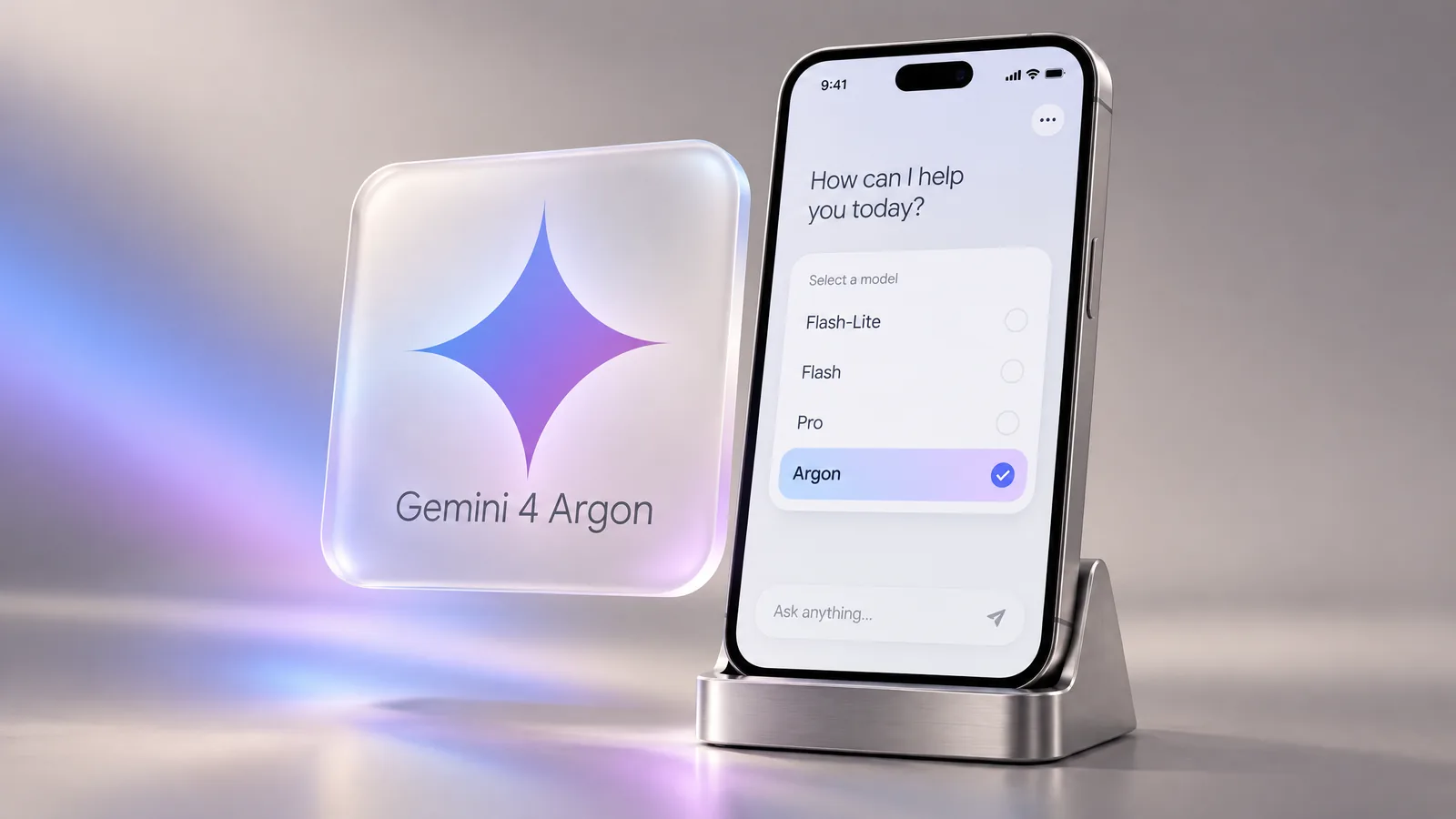
Gemini 4 Argon is Google's new frontier model, generally available since October 13, 2026 and built for long, multi-step work. In the Gemini app you need Google AI Pro ($19.99 a month) or AI Ultra; developers pay $2 per million input tokens until November 30, then twice that. This guide skips the launch hype and answers the practical questions: which plan gets what, how to switch to it, how to spend your usage limit, and what Google's benchmark table actually says once you read past the headline.
- In the Gemini app, Argon is limited to AI Pro ($19.99/month) and AI Ultra (from $99.99/month); Free and AI Plus users don't get it.
- API pricing is introductory: $2 input and $10 output per million tokens through November 30, 2026, then $4 and $20.
- Input and output share a 1 million token limit; it reads text, images, audio and video and answers in text.
- Google's own model card puts it first on knowledge work and long context, but behind GPT-6 Astra and Claude Opus 5.5 on two of four coding tests.
- A new chat-to-tasks toggle lets Pro and Ultra subscribers hand Argon longer jobs that keep running while they're away.
What is Gemini 4 Argon?
Argon is the model Google now calls its latest frontier model. It was opened to developers, enterprises and consumers on October 13, 2026, after a period in which access was limited to partners in Google’s Fairwind cybersecurity program. Google positions it for multi-step work in coding, finance, law, cybersecurity and science rather than quick chat.
According to the DeepMind model card, it is a sparse mixture-of-experts transformer that accepts text, images, audio and video files and returns text only. Its knowledge cutoff is March 2026, and input plus output can reach 1 million tokens combined. Google’s API pricing page notes that it supports long-decode generation, so a single response can itself run up to that 1 million token limit.
Google also makes claims about tone that users will notice on day one: answers are meant to be more direct, with less hedging, less repetition and fewer stock phrases. On long tasks it is supposed to report progress more often, and it follows style instructions more reliably than previous Gemini versions.
Which Google AI plan includes it?
Google’s US subscription page and the Gemini Help Center model table agree on the basics. The table below combines both (checked October 19, 2026):
| Plan | US price per month | Models in the chat picker | Tasks mode | Argon access |
|---|---|---|---|---|
| Free | $0 | Auto or Flash-Lite | Not available | No |
| AI Plus | $4.99 | Flash-Lite, Flash, Pro | Not available | No |
| AI Pro | $19.99 | Flash-Lite, Flash, Pro, Argon | Flash, Argon | Gemini app, AI Mode in Search |
| AI Ultra | From $99.99 | Flash-Lite, Flash, Pro, Argon | Flash, Argon | Adds Antigravity desktop and CLI, AI Studio |
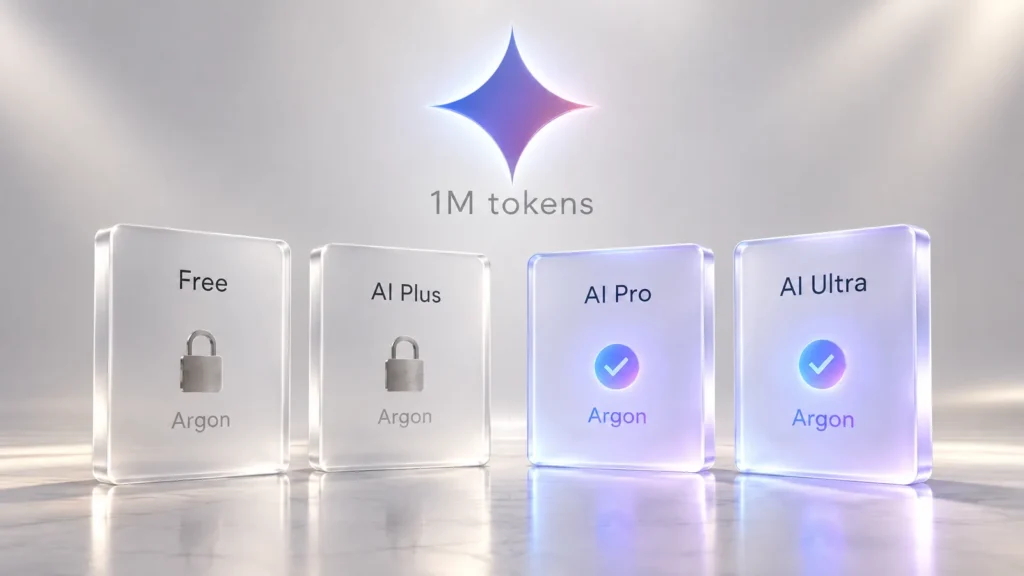
One wrinkle: a note on the US subscription page currently hints that AI Plus includes Argon, while the page banner, the Help Center table and Google’s launch post all limit it to Pro and Ultra. We went with the Help Center, which is the page Google keeps for plan-by-plan model access.
For most people the decision is between Pro and Ultra. Ultra’s extra value with Argon is not the model itself but the tooling around it and the headroom: 9to5Google reports that the Antigravity desktop app, its command-line tool and AI Studio access require Ultra, and the entry Ultra tier comes with five times Pro’s usage limits. If you mainly want Argon for chat, documents and tasks, Pro covers it.
How to switch to Argon in the Gemini app
The Help Center steps for the web and Android:
- Open gemini.google.com or the Gemini app.
- Tap the model name shown at the bottom of the chat box.
- Choose Argon. A lock icon means your plan doesn’t include that model.
- Optionally set the thinking level to Low, Medium or High. Low is the default.
The chat remembers both the model and the thinking level, so returning to an old conversation keeps you on Argon. To confirm which model wrote a reply, open More under the response and choose See response details. The rollout is staged worldwide, so if Argon isn’t in your picker yet, it may simply not have reached your account.
Chat versus tasks
Argon arrived together with a toggle in the main chat window that switches between chat and tasks. In tasks mode Gemini can keep working on a longer job while you’re away from your computer, and on Pro and Ultra you can run tasks on either Flash or Argon. On the Mac, the Gemini app now also opens Google Antigravity, where a coding agent drafts a plan for your approval, builds and tests in the background and pings you when it’s ready. That Mac integration is English-only for now and limited to users 18 and over in supported regions.
Usage limits: when Argon is worth it
Google hasn’t published a separate message cap for Argon. Gemini limits depend on prompt complexity, the features you use and conversation length; they reset every five hours, with a weekly ceiling on top, and you can extend them with AI credits. The Help Center is explicit that advanced models and higher thinking levels consume more of that allowance. When you hit the limit the chat doesn’t stop, it falls back to Flash-Lite.
- Use Argon for: the jobs Google itself highlights, such as analyzing financial reports, building presentations from mixed sources and creating interactive 3D models, plus long contracts, multi-file comparisons and multi-step coding.
- Keep 3.1 Pro for: everyday writing, summaries and single-document analysis. It is still in the picker and handles most of this well.
- Flash or Flash-Lite is enough for: quick questions, email drafts, translation and fact checks.
Start on Low thinking and only raise it when the first answer falls short. It is the easiest way to stretch a weekly allowance on Argon.
Gemini 4 Argon vs GPT-6 Astra and Claude: the benchmarks
These figures come from Google’s model card (checked October 19, 2026). They are Google’s own reported results, and independent testing may differ.
| Benchmark | Argon | GPT-6 Astra | Claude Opus 5.5 | Claude Fable 5.1 |
|---|---|---|---|---|
| Vals Index (knowledge work) | 68.9% | 63.1% | 67.0% | 65.8% |
| AutomationBench | 51.3% | 41.4% | 42.5% | 31.4% |
| DeepSWE v1.1 | 77.9% | 74.1% | 74.2% | 67.4% |
| FrontierSWE v2 | 55.0% | 65.5% | 62.3% | 56.3% |
| Terminal-bench 4.0 | 57.4% | 58.2% | 66.4% | 57.9% |
| GraphWalks BFS, 256k to 1M | 84.2% | 71.8% | 66.8% | 65.0% |
| LVBench (video understanding) | 91.7% | 87.5% | 83.7% | 79.7% |
Read together, the numbers tell a clear story. Argon’s lead is widest on long-context retrieval and agent-style knowledge work, which matches how Google is pitching it. Coding is split: it tops DeepSWE and Vibe Code Bench but trails GPT-6 Astra on FrontierSWE v2 and Claude Opus 5.5 on Terminal-bench 4.0. If your main reason to switch is coding, run your own repository through it before committing.
Google also reports some results from its own use. Teams using Argon in Antigravity submitted over 35% more agentic code changes, and rollbacks fell by nearly a third. On safety, it says attack success on the Gray Swan indirect prompt injection benchmark dropped to 0.7% across 15 adaptive attempts.
Gemini 4 Argon price in the API
Developers call the model as gemini-4-argon. It is not on the free tier, and the price changes on December 1, 2026:
| Per 1M tokens | Argon until Nov 30 | Argon from Dec 1 | Gemini 3.1 Pro (prompts up to 200k) |
|---|---|---|---|
| Input | $2.00 | $4.00 | $2.00 |
| Output, incl. thinking | $10.00 | $20.00 | $12.00 |
Cached input is $0.10 per million tokens during the introductory period and $0.20 afterwards, and Batch mode halves every rate. Unlike 3.1 Pro, which charges $4 input and $18 output once a prompt passes 200k tokens, Argon has no separate long-context tier. The practical takeaway: after November 30, Argon costs more than 3.1 Pro for short prompts, while the gap narrows for very long ones. Budget a new project at the December rates, not the launch rates.
Who should upgrade for it?
If your work involves long reports, contracts, research papers or several files at once, Argon is the strongest option Gemini has offered so far, and AI Pro is the cheapest way in. For everyday questions and short writing, 3.1 Pro and Flash remain perfectly adequate, and leaving Argon on for every chat only burns through your allowance faster. Ultra makes sense if you live in Antigravity or AI Studio, not for the model alone.
Scientists have a separate route: Google is offering 10,000 researchers six months of free access to Antigravity’s highest usage tier, subject to eligibility and selection.
Frequently asked questions
Is Gemini 4 Argon free?
No. In the Gemini app it is limited to Google AI Pro and AI Ultra subscribers, and it is not available on the Gemini API free tier.
How much does Gemini 4 Argon cost?
Through the app, the cheapest route is Google AI Pro at $19.99 a month in the US. In the API it costs $2 per million input tokens and $10 per million output tokens until November 30, 2026, then $4 and $20.
Is Gemini 4 Argon better than GPT-6 Astra?
On Google's own model card, Argon leads on knowledge work, long-context and multimodal tests, but GPT-6 Astra scores higher on FrontierSWE v2 and Terminal-bench 4.0. Which is better depends on your workload, and these are vendor-reported numbers.
What is the context window of Gemini 4 Argon?
Input and output share a limit of up to 1 million tokens, according to the model card. Its knowledge cutoff is March 2026.
Why don't I see Argon in my model picker?
Google is rolling it out in stages worldwide, so it may not have reached your account yet. It also requires AI Pro or AI Ultra; on work or school accounts, availability depends on your Workspace license.
Sources
- Gemini 4 Argon: Built to solve your hardest problems — Google, 19 October 2026
- Gemini 4 Argon is now available in the Gemini app — Google, 19 October 2026
- Gemini 4 Argon Model Card — Google DeepMind, 19 October 2026
- Google AI plans — Google, 19 October 2026
- Choose a model and thinking level in Gemini Apps — Google Help Center, 19 October 2026
- Gemini Apps release notes — Google, 19 October 2026
- Gemini Developer API pricing — Google AI for Developers, 19 October 2026
- Gemini app rolling out Gemini 4 Argon to AI Pro and AI Ultra — 9to5Google, 19 October 2026