

AI Tools Blog
Claude Haiku 5.5: Pricing, Speed and When to Use It

Claude Haiku 5.5 is Anthropic's new small model, released on October 7, 2026 and billed as "our fastest, cheapest, and most capable small model yet". For prompts up to 100,000 tokens, input is $0.10 per million tokens and output is $0.50, roughly a tenth of what Haiku 4.5 cost. Context grows to 1M tokens, adaptive thinking lands on Haiku for the first time, and the model is available on the Claude API, Amazon Bedrock, Google Cloud and Microsoft Foundry.
- Pricing is tiered at a 100k-token prompt threshold: $0.10 per million input tokens below, $0.50 above (5x higher across the board).
- Context window grew from 200k to 1M tokens; sync Messages API still caps output at 128k tokens per response.
- Adaptive thinking with an adjustable effort setting arrives in Haiku for the first time; default effort is medium.
- Haiku 5.5 is live on the Claude API, Amazon Bedrock, Google Cloud, Microsoft Foundry and Claude Platform on AWS under the model ID claude-haiku-5-5.
What is Claude Haiku 5.5?
Anthropic shipped Claude Haiku 5.5 on October 7, 2026 and calls it “our fastest, cheapest, and most capable small model yet”. It replaces Haiku 4.5 as the small-and-fast option in the Claude lineup; the model ID is claude-haiku-5-5. It accepts text and image input, returns text, and supports multilingual output, vision and tool use.
Two shifts matter. The first is price: Anthropic cut Haiku’s rates by about an order of magnitude for short prompts. The second is that an adjustable effort parameter lands in Haiku for the first time, so you can tell the model to think harder or barely at all. On top of that, the context window grew from 200,000 to 1,000,000 tokens, and Haiku now uses the same tokenizer family as Sonnet 5.5 and Opus 5.5.
Claude Haiku 5.5 pricing: the 100k-token tier
Haiku 5.5 ships with a two-tier price list. For any single request, if the prompt is 100,000 tokens or shorter, the base rates apply; cross that threshold on the same request and every row is multiplied by five. Per million tokens (claude.com pricing page, checked October 15, 2026):
| Rate | Prompts ≤ 100k tokens | Prompts > 100k tokens |
|---|---|---|
| Input | $0.10 | $0.50 |
| Output | $0.50 | $2.50 |
| Cache read | $0.01 | $0.05 |
| Cache write | $0.125 | $0.625 |
Anthropic’s launch post says roughly 90% of Haiku 4.5 requests fit under the 100k threshold, so most workloads land at the lower prices. The Message Batches API cuts both tiers in half, and prompt-cache reads sit at 10% of the base input price.
Instead of claiming a straight 10x cut, Anthropic reports a more realistic number for a migration: an average workload runs about 75% cheaper on Haiku 5.5 than on Haiku 4.5. The gap narrows because the model now writes more output tokens when it thinks, and some requests tip into the long-context tier.
Context window, speed and adaptive thinking
Per the Claude models page, Haiku 5.5 handles a 1,000,000-token context window, which Anthropic estimates at about 555,000 words or 2.5 million Unicode characters on the current tokenizer. The synchronous Messages API caps a single response at 128,000 tokens; the Message Batches API will go up to 300,000 output tokens with the output-300k-2026-03-24 beta header.
Thinking is new to the Haiku line. The models page lists Haiku 5.5’s thinking as adaptive, with a default effort of medium and an API parameter that accepts lower or higher levels. In adaptive thinking the model decides how much to reason on each prompt, steered by that effort setting. Higher effort uses more output tokens, which eats into Haiku’s price advantage; for classification, extraction and routing jobs, a low effort setting usually keeps costs honest.
Haiku 5.5’s reliable knowledge cutoff is June 2026, meaning anything newer should come through tool use (web search, database queries) rather than from the model’s own memory.
Claude Haiku 5.5 vs Sonnet 5.5 vs Opus 5.5
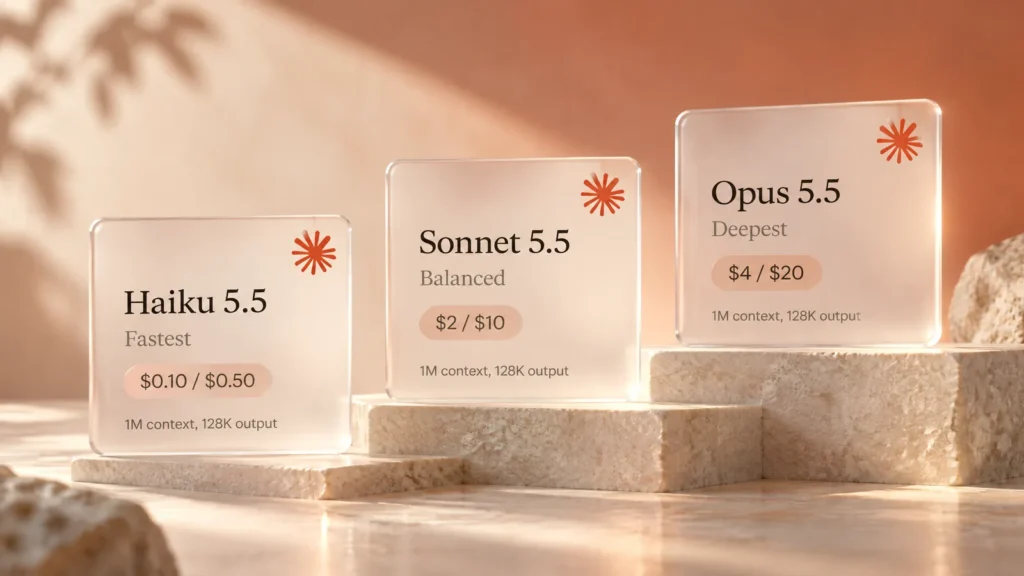
The current Claude lineup looks like this on Anthropic’s models page (checked October 15, 2026; prices per million tokens; Haiku price shown is the sub-100k tier):
| Model | Latency | Input / Output | Default effort | Best for |
|---|---|---|---|---|
| Opus 5.5 | Moderate | $4 / $20 | Medium | Long-running agentic coding and knowledge work |
| Sonnet 5.5 | Fast | $2 / $10 | High | Best combination of speed and intelligence |
| Haiku 5.5 | Fastest | $0.10 / $0.50 | Medium | High-volume, latency-sensitive tasks |
All three share a 1M-token context window and 128k max output, all three accept text plus image input, speak many languages, and use tools. The real decision is the intelligence-speed-price triangle. On Artificial Analysis’s Intelligence Index, Haiku 5.5 jumps 26 points over the previous Haiku to a score of 43, sitting just ahead of Gemini 3.8 Flash (41) and GLM-5.3 Flash (42) and alongside Kimi K3 (44). Sonnet 5.5 at max effort still leads Haiku 5.5 by 13 points.
Small models carry less factual breadth. Artificial Analysis’s AA-Omniscience evaluation puts Haiku 5.5 at 36% accuracy, behind Sonnet and Opus, though with a relatively low hallucination rate. For fact-heavy answers, pair Haiku 5.5 with web search or a connected knowledge source rather than relying on it alone.
When Haiku 5.5 is the right choice
Anthropic positions Haiku 5.5 for “high-volume, latency-sensitive tasks”, which translates into two questions: how many requests per day do you send and how long will your users wait? Haiku 5.5 fits naturally into:
- Classification and tagging: prioritising support tickets, labelling the type of an email.
- Extraction: pulling structured fields out of invoices, contracts or messages into JSON.
- Routing: filtering which prompts should escalate to a larger model, or handling an agent’s sub-tasks.
- Summarisation and memory compaction: turning long chat transcripts or database rows into short summaries.
- Live customer support: first-touch replies and categorisation where latency matters.
For complex code generation, long-horizon agent runs and heavy reasoning, Sonnet 5.5 or Opus 5.5 remain the right picks. Haiku 5.5 slots underneath them as the cheap worker: the agent’s repeated sub-tasks run on Haiku, the hard decision runs on Opus.
Where to access Claude Haiku 5.5
Anthropic published Haiku 5.5 on every supported Claude surface at once:
- Claude API: direct calls from platform.claude.com with the model ID claude-haiku-5-5.
- Amazon Bedrock: the Messages-API ID anthropic.claude-haiku-5-5; AWS sets its own lifecycle and regional endpoints.
- Google Cloud (Vertex AI): the same claude-haiku-5-5 ID, available via Google’s regional and global endpoints.
- Microsoft Foundry: your deployment names its own alias, Foundry maps to the Claude API ID underneath.
- Claude Platform on AWS: Anthropic’s first-party service running on AWS infrastructure.
Anthropic’s deprecation table commits to keeping Haiku 5.5 live for at least a year: retirement “not sooner than October 7, 2027” on the first-party Claude API, with Bedrock and Vertex following their own schedules.
Is Haiku 5.5 in Claude Pro and Max?
The claude.ai consumer app also lists Haiku 5.5 under its model picker. According to the pricing page (checked October 15, 2026), the Free plan already includes access to Sonnet and Haiku models; Opus and Claude Code unlock on Pro ($20/month, or $17/month billed annually). Heavier users can step up to Max 5x at $100/month or Max 20x, which multiply Pro’s usage ceiling. Team seats start at $20/seat/month (annual) and Enterprise lists the same seat price with an added API-rate usage charge.
Pro and Max subscriptions do not cover API billing: anything you call from your own code pays the per-token rates in the pricing table above.
A sensible first test: run a classification or extraction task on Haiku 5.5 with effort: low. If accuracy holds, that is the model for the job. If it slips, raise effort to medium; if it still slips, move the task to Sonnet 5.5.
Frequently asked questions
Is Claude Haiku 5.5 really a tenth of the price of Haiku 4.5?
For prompts up to 100,000 tokens, yes: $0.10 per million input tokens and $0.50 output, versus $1 and $5 on Haiku 4.5. Above the 100k threshold, every rate is five times higher, so very long prompts cost more. Anthropic reports an average workload runs about 75% cheaper after migration, with the gap narrowing because the model now writes more output tokens when it thinks.
When was Claude Haiku 5.5 released?
Anthropic published the launch post on October 7, 2026, with Haiku 5.5 available immediately on the Claude API, Amazon Bedrock, Google Cloud and Microsoft Foundry. The deprecation table commits to supporting it on the first-party API at least until October 7, 2027.
Does Haiku 5.5's 1M-token context mean every request costs five times more?
No. The pricing tier is set by the prompt's own token count, not by the model's maximum context window. A request that stays under 100,000 tokens pays the base rates even though the model could, in principle, read up to a million. Only requests that cross 100k tokens flip to the higher tier for that call.
How do I turn thinking on for Haiku 5.5, and what is the default?
The models page lists Haiku 5.5's thinking as adaptive with a default <strong>effort</strong> of medium. You adjust it by setting the effort parameter on your API call, with values such as low, medium or high. For classification and extraction jobs, low effort usually keeps costs predictable; use higher effort when answers need reasoning across steps.
Can Haiku 5.5 replace Sonnet 5.5 for coding?
For well-scoped helper tasks, often yes; for designing complex systems or running long multi-step agents, Sonnet 5.5 and Opus 5.5 remain stronger. Artificial Analysis's Intelligence Index puts Sonnet 5.5 at max effort 13 points above Haiku 5.5. In practice, teams layer them: Haiku handles sub-tasks and filters, Sonnet or Opus takes the harder decisions.
Which Claude plan unlocks Haiku 5.5 on claude.ai?
All of them. The Claude pricing page lists Sonnet and Haiku access on the Free plan already; Opus and Claude Code arrive on Pro ($20/month, $17 with annual billing). Max 5x and Max 20x raise the usage ceiling for heavy users but keep the same model set.
Sources
- Introducing Claude Haiku 5.5 — Anthropic, 15 October 2026
- Claude models overview — Anthropic (Claude Platform), 15 October 2026
- Claude pricing — Anthropic, 15 October 2026
- Claude Platform release notes — Anthropic (Claude Platform), 15 October 2026
- Anthropic has released Claude Haiku 5.5 — Artificial Analysis, 15 October 2026